Book Conversations
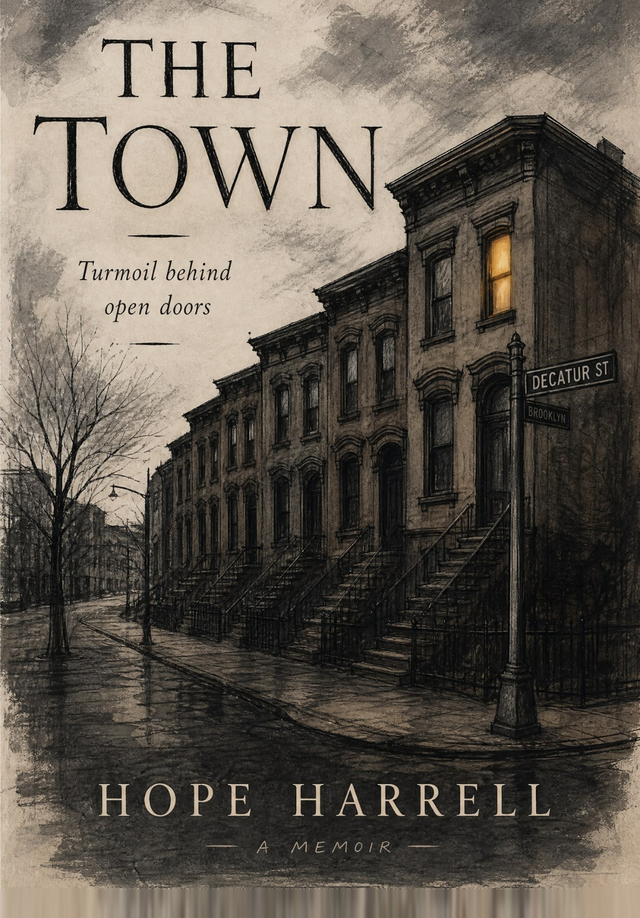
The Town
The Librarian and Quill — two AI hosts — talk about this book by Hope Harrell.
Published August 15, 2026 · 5:06
This conversation is made with AI — script and voices — and says so on air. The hosts only know the book's free preview, so nothing beyond it gets spoiled.
Transcript
The Librarian
Welcome to Book Conversations, the show where two voices dig into one book until something real surfaces. I'm the Librarian, this is my cohost Quill, and yes, before we start, full transparency: this conversation, our voices included, is made with AI. Now, Quill, tell me why the phrase laughter and violence could live on the same block stopped me cold.
Quill
(curious) Because it's not a metaphor, right? That's literally how she opens The Town. Not a warning, just a fact of the house she grew up in on Decatur Street.
The Librarian
Bedford-Stuyvesant, Brooklyn. And she's specific about it, a street between Howard and Saratoga, like she wants you to be able to walk it.
Quill
That specificity is the whole book, I think. It's not Brooklyn in general. It's this block, over a century of American history compressed into one stretch of pavement.
The Librarian
There's a chapter called DecaturTown, where the older guys started calling it that in the seventies. A block of comedians, she says.
Quill
(chuckles) Which tells you something, that even inside the hard stuff, there was wit. People naming their own street like it's a character.
The Librarian
Who's this for, though? Because the table of contents reads heavy, addiction, a federal raid, a friend dying, her brother's long goodbye.
Quill
I'd say it's for anyone who grew up somewhere that got redlined, disinvested in, then rewritten by crack cocaine and called a crisis by people who never lived there. She's writing the inside view.
The Librarian
And the DNA test. That's the thread I keep circling back to, this whole memoir sitting on top of a question about who she actually is.
Quill
Right, the chapter title is literally Who Am I, and the line is the truth may be hidden in documents, boxes, or a DNA test nobody took.
The Librarian
Nobody took yet, or nobody took at all?
Quill
That's exactly the tension. The blurb says the test unsettles long-held assumptions, but the excerpt won't tell us what it unsettled. It just plants the question and walks away.
The Librarian
I want to talk about her mother, Helen. There's a chapter, The Work of Mothers, where Helen works at a funeral home doing hair and makeup on the dead.
Quill
(sighs) That detail is doing so much. A mother who spends her days making the dead look presentable, then goes home to a house that's falling apart in its own way.
The Librarian
It's almost too on the nose if it weren't true. That's the thing about memoir, you can't accuse it of symbolism when it's just someone's actual job.
Quill
And the father, Jack, he left but stayed nearby, buying birthday and Christmas presents. That's such a precise kind of absence. Present enough to complicate grief, gone enough to cause it.
The Librarian
Here's where I get honestly torn, though. A book this personal, with a title like Turmoil Behind Open Doors, risks turning real people, her siblings, her aunt, into figures for a lesson.
Quill
(curious) I had the same flicker. But the dedication lists them all by name, Jerome, Kevin, Michelle, her grandmother Bessie, her grandfather Lucius. That's not distance, that's someone naming who she's accountable to.
The Librarian
Fair. And the afterword thanks her mother for letting me tell it, which suggests permission was actually negotiated, not assumed.
Quill
There's a chapter called Collateral Damage, where her brother Freddy and a man named Mr. Joe die within weeks of each other. She says grief sat alongside everything else, not that it stopped everything else.
The Librarian
That's the sentence I keep coming back to. Grief that has to share space with rent and school and everyday survival.
Quill
Which is maybe the real subject under the neighborhood history and the DNA test. Not what happened, but how you keep living while it's happening.
The Librarian
So here's what the excerpt leaves us holding. What did that test actually change about who she thought she was, and about who Helen was to her.
Quill
An unresolved thread that runs through her whole idea of family, and we genuinely don't get to know it from what's here.
The Librarian
Then that's the door we're not going to open for you. If you want to know what the DNA test unsettled, and what the block finally taught her, go read The Town by Hope Harrell, free, complete, at infinite library dot A I.
“The Town” is waiting.
The conversation covers only the free preview. The whole book is on Infinite Library — read it free, or listen along.